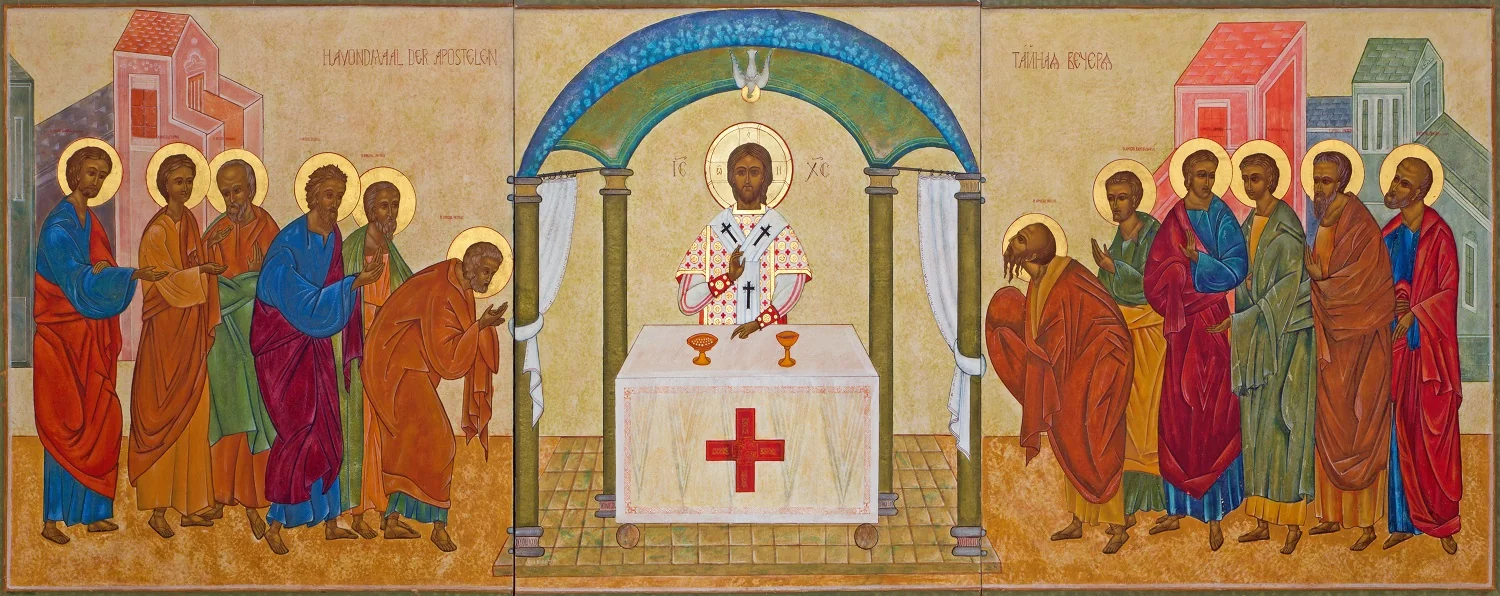
Follow these eleven selections through thanksgiving, heavenly praise, Christ’s self-offering and the Church’s common life. Each passage has a brief context and a connection to the Anaphora.
Psalm 49:14, 23 (50)
SAAS (Orthodox Study Bible Old Testament) · Verses 14 and 23; two excerpts
In this psalm God addresses His people about sacrifice. Everything already belongs to Him; He calls for praise and a life faithful to His covenant. These two verses come from separate parts of that address.
Offer to God a sacrifice of praise, And pay your vows to the Most High.
A sacrifice of praise shall glorify Me, And there is the way whereby I will show him the salvation of God.
The Anaphora offers thanksgiving and praise to God. The psalm invites us to bring a grateful and faithful heart, rather than imagine that God needs something from us.
Read Psalm 49:14, 23 (50) in context ↗ (PDF, opens a new tab)Genesis 22:2
SAAS (Orthodox Study Bible Old Testament) · Verses 1–2
God tests St. Abraham by calling him to offer his beloved son Isaac. Later in the account God stops Abraham from harming Isaac and provides a ram in his place.
Now it came to pass after these things that God tested Abraham, and said to him, “Abraham! Abraham!” And he said, “Here I am.” Then He said, “Take now your beloved son, Isaac, whom you love, and go to the land of Moriah, and offer him there as a whole burnt offering on one of the mountains I tell you.”
Read this call beside John 3:16 and the remembrance of Christ’s saving Passion in the Anaphora. The beloved son and the offering prepare us to reflect on the Father’s gift of His Son.
Read Genesis 22:2 in context ↗ (PDF, opens a new tab)Hosea 6:6
SAAS (Orthodox Study Bible Old Testament)
Through St. Hosea, the Lord rebukes Israel and Judah because their mercy vanishes like morning dew. He calls for lasting faithfulness and knowledge of Him.
For I desire mercy and not sacrifice, And the knowledge of God More than whole burnt offerings.
The Church offers the Eucharistic sacrifice in a life called to mercy. As we give thanks, this verse asks whether our relationships and actions answer the God whom we worship.
Read Hosea 6:6 in context ↗ (PDF, opens a new tab)1 Corinthians 10:16
NKJV (Orthodox Study Bible New Testament) · Verses 16–17
St. Paul warns the Corinthians against idolatry and explains their participation in Christ. He connects the shared cup and bread with the unity of the many who receive them.
The cup of blessing which we bless, is it not the communion of the blood of Christ? The bread which we break, is it not the communion of the body of Christ? For we, though many, are one bread and one body; for we all partake of that one bread.
The Anaphora is the prayer of the gathered Church. Communion in Christ’s Body and Blood unites us with Him and with one another.
Read 1 Corinthians 10:16 in context ↗ (opens a new tab)Matthew 26:26–28
NKJV (Orthodox Study Bible New Testament)
At the Mystical Supper, before His Passion, Jesus gives the disciples bread and the cup. He identifies them with His Body and the Blood of the new covenant.
And as they were eating, Jesus took bread, blessed and broke it, and gave it to the disciples and said, “Take, eat; this is My body.” Then He took the cup, and gave thanks, and gave it to them, saying, “Drink from it, all of you. For this is My blood of the new covenant, which is shed for many for the remission of sins.”
Listen for Christ’s words in the Eucharistic prayer. The gifts are received in thanksgiving for His self-offering and the forgiveness of sins.
Read Matthew 26:26–28 in context ↗ (opens a new tab)Revelation 5:12
NKJV (Orthodox Study Bible New Testament) · Verses 11–12
St. John sees the Lamb standing as though slain, surrounded by the heavenly assembly. The angels proclaim the worthiness of the Lamb who has redeemed His people.
Then I looked, and I heard the voice of many angels around the throne, the living creatures, and the elders; and the number of them was ten thousand times ten thousand, and thousands of thousands, saying with a loud voice: “Worthy is the Lamb who was slain To receive power and riches and wisdom, And strength and honor and glory and blessing!”
The Anaphora brings our thanksgiving into heavenly worship. The Lamb’s glory is inseparable from His saving sacrifice.
Read Revelation 5:12 in context ↗ (opens a new tab)Revelation 4:8
NKJV (Orthodox Study Bible New Testament)
St. John describes the throne of God and the living creatures around it. Their unceasing hymn proclaims the holiness of the eternal Lord.
The four living creatures, each having six wings, were full of eyes around and within. And they do not rest day or night, saying: “Holy, holy, holy, Lord God Almighty, Who was and is and is to come!”
When we sing “Holy, holy, holy” in the Anaphora, the congregation joins the praise of the heavenly hosts. Attend to the holiness of the One before whom we stand.
Read Revelation 4:8 in context ↗ (opens a new tab)John 3:16
NKJV (Orthodox Study Bible New Testament)
During His conversation with Nicodemus, Jesus speaks about new birth, heavenly things and the saving gift of the Son. The verse names God’s love as the source of that gift.
For God so loved the world that He gave His only begotten Son, that whoever believes in Him should not perish but have everlasting life.
The Eucharistic prayer gives thanks to the Father for His love and for the saving work of His Son. Our offering answers a gift that God has already made.
Read John 3:16 in context ↗ (opens a new tab)Ephesians 5:2
NKJV (Orthodox Study Bible New Testament) · Verses 1–2
St. Paul calls Christians to forgive one another and to live as God’s beloved children. Christ’s self-offering is the pattern of the love they are to practice.
Therefore be imitators of God as dear children. And walk in love, as Christ also has loved us and given Himself for us, an offering and a sacrifice to God for a sweet-smelling aroma.
The sacrifice we remember in the Anaphora is Christ’s gift of Himself in love. Our thanksgiving calls us to carry that love into our life with others.
Read Ephesians 5:2 in context ↗ (opens a new tab)Luke 22:19–20
NKJV (Orthodox Study Bible New Testament)
At the Mystical Supper Jesus speaks to His apostles before His suffering. He gives thanks, shares the bread and cup, and commands them to do this in remembrance of Him.
And He took bread, gave thanks and broke it, and gave it to them, saying, “This is My body which is given for you; do this in remembrance of Me.” Likewise He also took the cup after supper, saying, “This cup is the new covenant in My blood, which is shed for you.”
The Anaphora remembers Christ’s saving work in obedience to His command. Thanksgiving and remembrance belong together in the Church’s offering.
Read Luke 22:19–20 in context ↗ (opens a new tab)1 Chronicles 29:14
SAAS (Orthodox Study Bible Old Testament)
After the people willingly bring gifts for the temple, King David blesses the Lord before the assembly. He acknowledges that even their ability to offer comes from God.
“But who am I, and who are my people, that we are able to be zealous in offering to You? For all things are Yours, and of Your own we give to You.”
“Your own of Your own we offer to You” expresses this same grateful dependence. We offer what we have first received from the Lord.
Read 1 Chronicles 29:14 in context ↗ (PDF, opens a new tab)