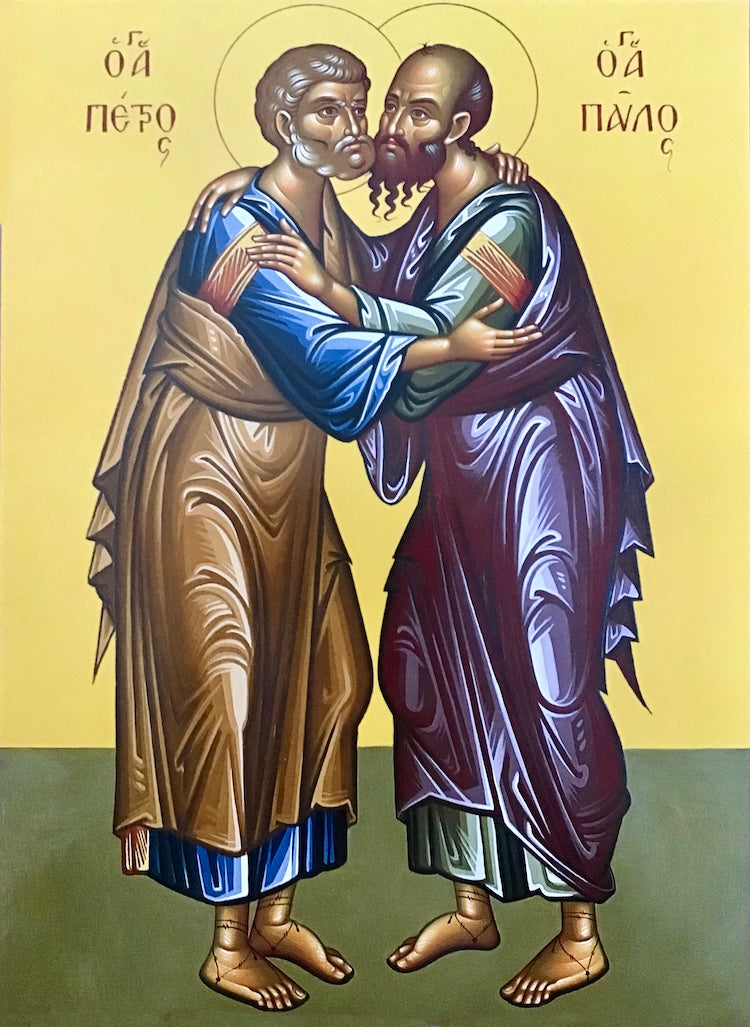
Follow the completion of our prayer, the call to love one another, and the confession of the Church’s faith.
Read the introduction, using “Terms used in this lesson” for unfamiliar words.
Read the eight Scripture selections in order, noticing trust in God, repentance, peace and confession.
Read the three Fathers’ comments on love, the Creed and thanksgiving.
Try an optional study question, then keep an observation or question for the next parish meeting in your notes.
Terms used in this lesson
Completion Litany
The series of petitions after the Great Entrance, also called the Litany of Offering. It begins “Let us complete our prayer to the Lord” and includes prayer for the precious gifts and for our life in peace.
Proskomide / offering
Proskomide means offering. In this lesson’s title it names the litany after the gifts have been brought to the Holy Table. Lesson 3 used the same word for the earlier preparation of the bread and wine.
Kiss of peace
The liturgical greeting of reconciliation and love. St. Symeon and St. Cyril explain why preparation for Communion calls us to put aside anger and remembered wrongs.
Symbol of Faith / Creed
The Church’s confession of faith, beginning “I believe in one God.” St. Cyril describes this concise teaching as drawn from the whole of Scripture.
“The doors!”
The exclamation before the Creed: “The doors! The doors! In wisdom let us be attentive!” Attend to the confession that follows and to the Church’s preparation for the Eucharistic prayer.
Anaphora
The Eucharistic prayer of offering and thanksgiving that follows the Creed. St. Cyril’s third commentary looks ahead to its opening dialogue: “Let us give thanks to the Lord.”
Completing our prayer and confessing the faith
Also called the Completion Litany (“Let us complete our prayer...”; “For the precious gifts...”). Prayer here calls emphasis to God being the one who offers. Love is a prerequisite for right belief (“Let us love one another...”). Kiss of peace. “The doors!” and the Symbol of Faith (Creed).
Scripture selections for the Completion Litany and the Creed
Read these eight selections alongside the prayers for the gifts, the call to love one another, and the confession of faith. Each passage has a brief context and a connection to the lesson.
Psalm 33:8 (34:7)
SAAS (Orthodox Study Bible Old Testament)
David’s psalm gives thanks for the Lord’s deliverance and calls others to trust Him. This verse speaks of the Lord’s angel protecting those who fear Him.
The Angel of the Lord shall encamp around those who fear Him, And He will deliver them.
The petition for an angel of peace, a faithful guide and guardian, invites us to entrust our life to God’s protection.
SAAS (Orthodox Study Bible Old Testament) · Verses 20–21; David’s complete concluding encouragement
King David charges his son Solomon to build the house of the Lord. He encourages him with the promise that God will remain with him through the work.
And David said to his son Solomon, “Be strong and of good courage, and do it. Do not fear nor be dismayed, for the Lord God, my God, will be with you. He will not leave you nor forsake you until you have finished all the work for the service of the house of the Lord. And take notice of the division of the priests and Levites for all the daily service of the house of the Lord. With them shall be the men for every workmanship, every one of ready skill in every art. And at your command are the chief men and all the people.”
Prayer for the gifts and for our whole life rests on God’s help. David’s charge joins courage, faithful work and trust in the Lord’s presence.
SAAS (Orthodox Study Bible Old Testament) · Verses 2–6; the sentence continues through the humbling of the proud
St. Isaiah describes a song to be sung in Judah: God gives His people a strong city and salvation. The song joins righteousness, truth, peace and hope in God, who brings down the proud.
Open the gates; let the people enter who keep righteousness and guard the truth, and who lay hold of the truth and keep peace, because they hope forever in You, O Lord, the great and eternal God, who humbles and brings down those who dwell on high; the strong cities You will cast down; You will bring them down to the ground. The feet of the gentle and the humble shall tread them underfoot.
As we pray for peace and prepare to confess the faith, this song holds truth and trust in God together. Its peace belongs to a people learning righteousness.
NKJV (Orthodox Study Bible New Testament) · Verses 9–10; the preceding verse identifies the sorrow St. Paul describes
St. Paul reflects on the Corinthians’ response to a painful letter. He rejoices because their sorrow has led them to repentance.
Now I rejoice, not that you were made sorry, but that your sorrow led to repentance. For you were made sorry in a godly manner, that you might suffer loss from us in nothing. For godly sorrow produces repentance leading to salvation, not to be regretted; but the sorrow of the world produces death.
The petition for forgiveness calls us toward repentance that changes our life. It asks for healing and salvation, with hope rather than despair.
At the Annunciation, the Archangel Gabriel tells the Virgin Mary that she will bear the Son of God. She responds by freely entrusting herself to the Lord.
Then Mary said, “Behold the maidservant of the Lord! Let it be to me according to your word.” And the angel departed from her.
The call to commit ourselves, one another and our whole life to Christ invites the same willing trust expressed by the Theotokos.
St. James instructs the Church about prayer, sickness and healing. He joins the confession of sins with prayer for one another.
Confess your trespasses to one another, and pray for one another, that you may be healed. The effective, fervent prayer of a righteous man avails much.
Our prayer for pardon is also prayer for our neighbors. Confession and mutual intercession prepare us to stand before God together.
St. Paul calls Christians to put on mercy, kindness, humility, patience and love. He then speaks of the peace that governs the one body of Christ.
And let the peace of God rule in your hearts, to which also you were called in one body; and be thankful.
“Let us love one another” calls the whole congregation into the peace of one body. Thanksgiving and a reconciled heart belong to the confession that follows.
NKJV (Orthodox Study Bible New Testament) · Verses 8–10; the opening supplies the sentence leading into verse 9
St. Paul explains the word of faith proclaimed by the apostles. Belief in the heart and confession with the mouth are joined in the acknowledgment of the risen Lord Jesus.
But what does it say? “The word is near you, in your mouth and in your heart” (that is, the word of faith which we preach): that if you confess with your mouth the Lord Jesus and believe in your heart that God has raised Him from the dead, you will be saved. For with the heart one believes unto righteousness, and with the mouth confession is made unto salvation.
The Creed gives voice to the Church’s faith. This reading invites us to attend to what we confess and to believe it in our hearts.
Love and reconciliation. The confession of faith. The giving of thanks.
Read how love prepares us to confess the faith, how the Creed gathers Scripture, and why the Church gives thanks.
St. Symeon of Thessaloniki
The Liturgical Commentaries: Explanation of the Divine Temple · §71 · Course handbook, p. 14.
St. Symeon explains the kiss of peace in relation to the confession of the Trinity and the preparation for Communion. He gives three reasons for joining right confession with love.
After the first prayer, while the sacred creed is recited, the kiss occurs 1) because through the right confession of the Trinity, and of the one of the Trinity who was incarnate, the union with us has occurred. It is this confession which has united us to the angels. And 2) because it is necessary to love one another, since Christ was sacrificed through love, and because the one preparing to receive him in communion must not approach with anger, and 3) because in the future age all will be friends, and none will be enemies.
The kiss and the Creed call us to approach Christ without anger. The confession of faith and the love we practice belong to the same preparation.
How can the confession of the Trinity and the call to love one another prepare us to receive Christ?
St. Cyril of Jerusalem
Lectures on the Christian Sacraments, p. 49–50 · Catechetical Lecture 5 §12 · Course handbook, p. 14.
St. Cyril is teaching those preparing for baptism about faith. He explains why the Church gives them a concise confession drawn from the whole of Scripture.
This synthesis of faith was not composed according to human opinions; but the most important points collected out of all the Scripture make up one complete teaching of the Faith. And just as the mustard seed in one small grain contains many branches, so also this Faith has embraced in a few words all the religious knowledge in both the Old and New Testaments.
The Creed gathers the teaching of Scripture into a confession the Church can speak together. Its few words ask for attentive understanding, rather than hurried recitation.
Which words of the Creed help you recognize the unity of the Old and New Testaments?
St. Cyril of Jerusalem
Lectures on the Christian Sacraments, p. 125 · Mystagogical Catechesis 5 §5 (Catechetical Lecture 23) · Course handbook, p. 14.
St. Cyril explains the dialogue that opens the Eucharistic thanksgiving. The priest calls the people to give thanks, and they answer that it is right and just.
The priest says, “Let us give thanks to the Lord”. For rightly we are bound to give thanks, that he has called us, being unworthy, to such great grace, that, being enemies, he has reconciled us, and that he has made us worthy of the “Spirit of divine adoption” (cf. Rom 8.15). Next, you say, “It is right and just”. For by our giving thanks we do a right and just thing. But our Benefactor did not do only a just thing, but more than just, by making us worthy of such great love.
Reconciliation leads to thanksgiving. Looking ahead to the Eucharistic prayer, St. Cyril names the grace and adoption for which the reconciled Church gives thanks.
What gifts of reconciliation and adoption do you remember when you answer the call to give thanks?
Further studyAdditional Scripture and early Christian teaching
Explore these optional readings and commentaries alongside the lesson.
Additional Scripture readings
John 13:34–35
NKJV (Orthodox Study Bible New Testament)
At the Last Supper, after Judas has gone out, Christ speaks to His disciples about His coming departure and gives them the commandment to love.
A new commandment I give to you, that you love one another; as I have loved you, that you also love one another. By this all will know that you are My disciples, if you have love for one another.
The call to love before the Creed leads us to Christ’s own measure of love: “as I have loved you.” The congregation’s confession should become visible in its life.
St. Paul urges the Church to live according to its calling. He first names the humility, patience and love that preserve unity, then confesses the one faith and one God.
I, therefore, the prisoner of the Lord, beseech you to walk worthy of the calling with which you were called, with all lowliness and gentleness, with longsuffering, bearing with one another in love, endeavoring to keep the unity of the Spirit in the bond of peace.
There is one body and one Spirit, just as you were called in one hope of your calling; one Lord, one faith, one baptism; one God and Father of all, who is above all, and through all, and in you all.
Love, peace and common confession belong together. Read this passage alongside the kiss of peace and the Creed, noticing how a shared faith asks for a shared way of life.
Explaining the Eucharistic service to the newly baptized, St. Cyril describes the kiss that follows the washing of hands.
Then the Deacon cries aloud, “Receive ye one another; and let us kiss one another.” Think not that this kiss is of the same character with those given in public by common friends. It is not such: but this kiss blends souls one with another, and courts entire forgiveness for them. The kiss therefore is the sign that our souls are mingled together, and banish all remembrance of wrongs.
The call “Let us love one another” asks for the forgiveness expressed by the kiss. Carry this call into the Creed by laying aside remembered wrongs against another person.
Whose forgiveness could you seek before the next Liturgy?
St. Justin Martyr
First Apology · Chapter 65: Administration of the sacraments
St. Justin describes the Eucharistic gathering after a person has received baptism. The person who has been “washed” is the newly baptized Christian.
But we, after we have thus washed him who has been convinced and has assented to our teaching, bring him to the place where those who are called brethren are assembled, in order that we may offer hearty prayers in common for ourselves and for the baptized [illuminated] person, and for all others in every place, that we may be counted worthy, now that we have learned the truth, by our works also to be found good citizens and keepers of the commandments, so that we may be saved with an everlasting salvation. Having ended the prayers, we salute one another with a kiss.
Common prayer embraces the newly baptized and people everywhere. The kiss follows prayer for lives that keep Christ’s commandments, joining the Church’s confession to the love it must practice.
Which petition in the Completion Litany speaks most directly to your preparation for the offering?
Is there someone with whom you need to seek reconciliation before the next Liturgy?
Which words of the Creed would you like to understand more deeply? Bring that question to the parish meeting.
Notes, observations & questions
Keep something you noticed, or a question for the next parish meeting.
Enable JavaScript to save notes in your browser.
Importing merges the backup with your notes. It keeps existing text. Notes do not sync automatically between devices.
Sources
The Bible editions are the Orthodox Study Bible: St. Athanasius Academy Septuagint (SAAS) for the Old Testament and NKJV for the New Testament. Scripture excerpts are labelled; source links open the complete selected passage in a new tab.
Scripture in Service: A Parish Study of the Divine Liturgy, Lesson 7, printed pp. 14–15