← All lessonsLesson 6

The Litany and the Great Entrance

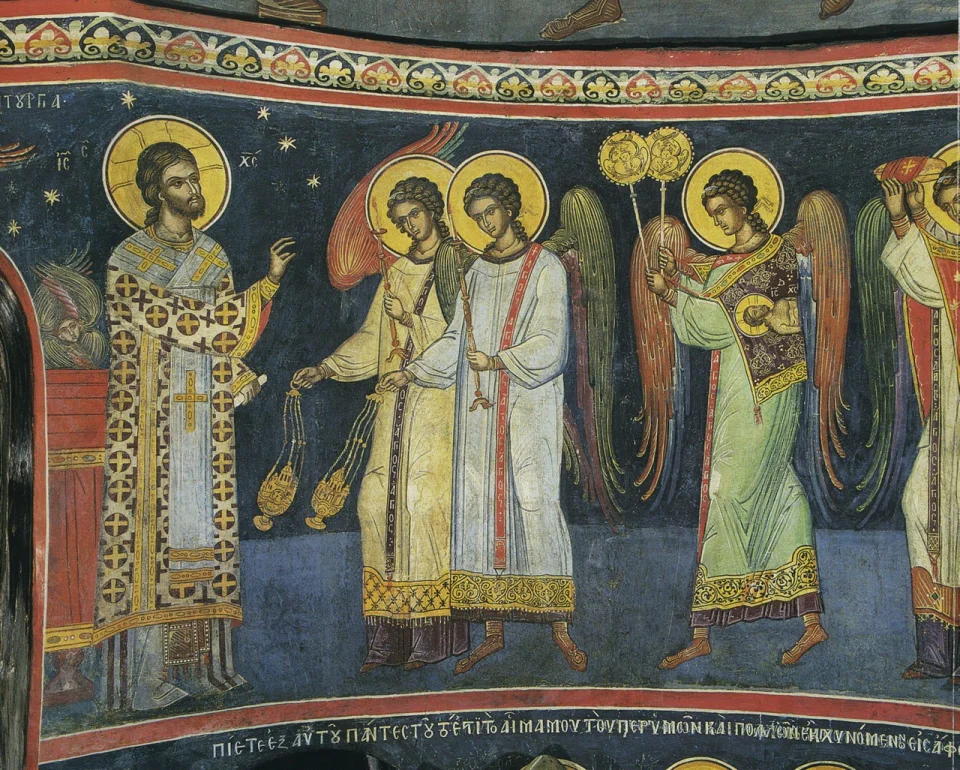
Historic fresco of Christ beside the altar and angels carrying censers, liturgical fans, and the gifts
A way through this lesson

Follow the prayers after the homily and the entrance of the gifts, then consider the heavenly worship and the prayer of the Church.

  1. Read the introduction, using “Terms used in this lesson” for unfamiliar words.
  2. Read the ten Scripture selections in order. Brief excerpts have context beside them; the source links open the complete passages.
  3. Read the three Fathers’ comments on the dismissal after the readings and the covering of the gifts.
  4. Try an optional study question and keep a prayer, observation, or question in your notes.
Terms used in this lesson
Catechumen
A person being instructed in the Christian faith in preparation for baptism. The litany for catechumens asks God to guide and prepare them.
Litany
A series of prayer requests offered by the deacon or priest, with the people responding. Here, litanies follow the homily and include prayer for catechumens.
Antimension
The consecrated cloth on the Holy Table, depicting Christ’s burial. It is opened for the celebration of the Eucharist.
Cherubic Hymn
The hymn sung around the Great Entrance. It invites the faithful to participate in heavenly worship and lay aside worldly cares as they prepare to receive the King of all.
Great Entrance
The procession carrying the prepared gifts of bread and wine to the Holy Table. It leads into the offering that follows the readings and prayers.
Proskomide
The preparation of the bread and wine for the Eucharist before the public Liturgy. The Great Entrance brings those prepared gifts to the Holy Table.

From the homily to the Great Entrance

After the homily, there is an appointed—but often omitted—litany. There is then a litany for the catechumens. Catechumens are dismissed. Two prayers for the faithful. The opening of the antimension, the priestly prayer, the recitation of the Cherubic Hymn, and censing. The “Great” Entrance with the gifts. This is the transition from “liturgy of the Word” into “liturgy of the faithful”. This ultimately completes the preparation (Proskomide) that began much earlier.

Scripture selections for the litanies and the Great Entrance

Read these ten passages alongside the prayers, the Cherubic Hymn, and the procession of the gifts. Each excerpt is identified; follow its source link to read the complete selection.

Matthew 15:21–28

NKJV (Orthodox Study Bible New Testament) · Verses 25 and 28; the intervening exchange is in the full reading

A Canaanite woman asks Jesus to free her daughter from demonic affliction. She persists through His silence and the difficult exchange about Israel, bread, and crumbs, trusting that His mercy can reach her daughter.

Then she came and worshiped Him, saying, “Lord, help me!”

Then Jesus answered and said to her, “O woman, great is your faith! Let it be to you as you desire.” And her daughter was healed from that very hour.

The mother’s appeal, Christ’s answer, and her daughter’s healing show prayer offered on behalf of another person. Bring that trust and concern for others to the Church’s intercessions.

Read Matthew 15:21–28 in context (opens a new tab)

Mark 11:25

NKJV (Orthodox Study Bible New Testament)

Jesus speaks to His disciples about prayer and forgiveness.

And whenever you stand praying, if you have anything against anyone, forgive him, that your Father in heaven may also forgive you your trespasses.

As the Liturgy turns toward the offering of the gifts, consider how forgiving another person belongs to our preparation for prayer.

Read Mark 11:25 in context (opens a new tab)

Ezekiel 10

SAAS (Orthodox Study Bible Old Testament) · Verse 4; read the complete vision in chapter 10

St. Ezekiel sees the cherubim beside the house and the Lord’s glory filling it. Later in this vision, given in the setting of judgment, the glory departs from the house.

Then the glory of the Lord went up from the cherubim into the inner court of the house. The cloud filled the house, and the court was filled with the brightness of the Lord’s glory.

The cherubim, the cloud, and the brightness of the Lord’s glory give substance to the language of heavenly worship in the Cherubic Hymn. The vision is a prophetic encounter with God’s glory; its connection with our worship is a theme to contemplate.

Read Ezekiel 10 in context (PDF, opens a new tab)

Isaiah 6:1–8

SAAS (Orthodox Study Bible Old Testament) · Verses 1–3; the full reading continues through verse 8

St. Isaiah sees the Lord enthroned in glory and hears the seraphim praising Him. The vision continues with the prophet’s cleansing and calling.

In the year King Uzziah died, I saw the Lord sitting on a throne, high and lifted up. The house was full of His glory. Around Him stood seraphim; each one had six wings: with two he covered his face, with two he covered his feet, and with two he flew. And one cried to another and said, “Holy, holy, holy is the Lord of hosts; the whole earth is full of His glory.”

The throne, the Lord’s glory, and the seraphim’s praise help us understand the heavenly worship to which the Cherubic Hymn directs our attention. Isaiah names seraphim; Ezekiel’s vision names cherubim. These prophetic visions invite us to join in praise of God.

Read Isaiah 6:1–8 in context (PDF, opens a new tab)

Psalm 140:2 (141)

SAAS (Orthodox Study Bible Old Testament)

The psalmist addresses the Lord in prayer.

Let my prayer be set forth before You as incense, The lifting up of my hands as the evening sacrifice.

The comparison of prayer with incense and raised hands helps us notice the censing and prayer before the Great Entrance.

Read Psalm 140:2 (141) in context (PDF, opens a new tab)

Luke 23:42

NKJV (Orthodox Study Bible New Testament)

The penitent criminal crucified beside Jesus asks to be remembered in His kingdom.

Then he said to Jesus, “Lord, remember me when You come into Your kingdom.”

The request to be remembered in the kingdom helps us hear the remembrance made during the Great Entrance. In the next verse, Jesus promises Paradise.

Read Luke 23:42 in context (opens a new tab)

Romans 8:26

NKJV (Orthodox Study Bible New Testament) · Intercession clause of verse 26

St. Paul explains that we do not know how to pray as we ought. In that weakness, the Holy Spirit helps us and intercedes for us; verse 27 continues with God’s knowledge of the heart and His will.

[T]he Spirit Himself makes intercession for us with groanings which cannot be uttered.

The passage places our prayer in dependence on the Holy Spirit. As we pray with the Church before the offering, we seek God’s help rather than relying only on our own ability to find words.

Read Romans 8:26 in context (opens a new tab)

Hebrews 4:16

NKJV (Orthodox Study Bible New Testament)

The passage identifies Jesus, the Son of God, as the great High Priest who understands our weakness. It then invites us to approach God.

Let us therefore come boldly to the throne of grace, that we may obtain mercy and find grace to help in time of need.

Approaching the throne of grace means seeking mercy and help through Christ. Read verses 14–16 together to hear why we can approach with confidence.

Read Hebrews 4:16 in context (opens a new tab)

Genesis 14:18

SAAS (Orthodox Study Bible Old Testament)

After Abram has rescued Lot, Melchizedek, the king of Salem and priest of God Most High, meets him.

Now Melchizedek the king of Salem brought out bread and wine; he was the priest of God Most High.

Verses 19–20 continue with Melchizedek’s blessing. Consider the bread, wine, and priestly service beside the offering of the gifts.

Read Genesis 14:18 in context (PDF, opens a new tab)

John 19:38–42

NKJV (Orthodox Study Bible New Testament) · Opening clause of verse 40; the full burial narrative is verses 38–42

After Jesus’ death, Joseph of Arimathea receives permission from Pilate to take His body. Nicodemus brings myrrh and aloes. Together they prepare the body and place it in a new tomb in a nearby garden.

Then they took the body of Jesus, and bound it in strips of linen with the spices.

The linen and spices make the reverent care for Christ’s body visible in the passage. Consider that care beside the preparation and covering of the gifts. St. Symeon’s explanation below draws attention specifically to Christ’s divinity hidden in His earthly life.

Read John 19:38–42 in context (opens a new tab)

Listening to the Fathers

The fulfillment of the Gospel.
The prayer of the faithful.
The covered gifts.

Read each commentary slowly, considering the transition after the Gospel and the gifts placed on the altar.

St. Symeon of Thessaloniki

The Liturgical Commentaries: Explanation of the Divine Temple · Course handbook, p. 12.

Right after the Sacred Readings and sermon, the catechumens are dismissed and the faithful are exhorted to remain. For this time represents the time of consummation, since Scripture says that when the Gospel has been preached throughout the whole world, “then the end will come”. And since at the end it says, “He will send His angels,” and they will separate the evil from the righteous, the Church also does this.

A question to carry into the service

How does St. Symeon connect the dismissal after the readings with the fulfillment of the Gospel?

St. Maximos the Confessor

The Church’s Mystagogy, p. 200 · Course handbook, p. 12.

After the divine reading of the holy Gospel the bishop descends from his throne and there takes place the dismissal and sending away of the catechumens and of others unworthy of the divine vision of the mysteries to be displayed. It signifies and figures by itself the truth, of which it is an image and figure, as if proclaiming thereby that after having preached, as is written, “the Gospel of the kingdom in the whole world as a witness to all the Gentiles,” the end will then appear in the second coming of our great God and Savior Jesus Christ from the heavens in glory.

A question to carry into the service

What does St. Maximos invite us to see beyond the outward movement of the service?

St. Symeon of Thessaloniki

The Liturgical Commentaries: Explanation of the Divine Temple · Course handbook, p. 13.

When the divine gifts have been set on the sacred altar, they are covered 1) because Jesus was not recognized by all from the beginning; and 2) because, though incarnate, he did not thereby give up the hidden quality of his divinity or his foreknowledge, but is always incomprehensible and infinite, and is known only insofar as he reveals himself.

A question to carry into the service

What does St. Symeon’s explanation of the covered gifts suggest about knowing Christ?

Further studyAdditional Scripture and early Christian teaching

Explore these optional readings and commentaries alongside the lesson.

Additional Scripture readings

James 5:13–16

NKJV (Orthodox Study Bible New Testament) · Verses 14–15; the complete reading is verses 13–16

St. James instructs the Christian community to turn to God in suffering and joy, then describes how the elders are to pray for someone who is sick.

Is anyone among you sick? Let him call for the elders of the church, and let them pray over him, anointing him with oil in the name of the Lord. And the prayer of faith will save the sick, and the Lord will raise him up. And if he has committed sins, he will be forgiven.

The elders, the sick person, and the prayer of faith show the Church caring for a person in need. Read this beside the intercessions for the faithful; the full passage continues with confession and prayer for one another.

Read James 5:13–16 in context (opens a new tab)

Revelation 5:8–14

NKJV (Orthodox Study Bible New Testament) · The song in verse 12; the complete vision is verses 8–14

St. John hears innumerable angels around the throne, the living creatures, and the elders praising the Lamb, Jesus Christ. Earlier in the scene, the elders hold bowls of incense identified with the prayers of the saints.

“Worthy is the Lamb who was slain To receive power and riches and wisdom, And strength and honor and glory and blessing!”

The praise names the Lamb who was slain and gives Him honor and glory. The Cherubic Hymn likewise turns our attention toward worship with the heavenly hosts, while the gifts are carried in preparation for the Eucharist.

Read Revelation 5:8–14 in context (opens a new tab)

More from the Fathers

St. John Chrysostom

Homily 2 on Second Corinthians · §6: prayer for catechumens

St. John Chrysostom is explaining the Church’s order of common prayer. The “law” here is that order, and the “uninitiated” are the catechumens preparing for baptism. He describes the deacon calling the whole congregation to pray for them.

For the law stirs up the faithful to make supplication for the uninitiated.

The faithful are asked to care for the catechumens through prayer. This commentary witnesses to the ancient practice of the congregation praying for those preparing to enter the Church, and helps us understand the litany named in the introduction.

A question to carry into the service

For whom preparing for baptism could you pray at the next Liturgy?

Prayer and preparation

Try these optional study activities. Each choice opens an explanation; there are no scores.

What does the penitent criminal ask of Jesus in Luke 23:42?
In Mark 11:25, what does Jesus ask those standing in prayer to do?
Questions for reflection
  • Whom would you like to remember in prayer during the Great Entrance?
  • What helps you set aside distractions and attend to the Cherubic Hymn?
  • How do the comments of St. Symeon and St. Maximos help you understand the transition after the readings?

Notes, observations & questions

Keep something you noticed, or a question for the next parish meeting.

Enable JavaScript to save notes in your browser.

Importing merges the backup with your notes. It keeps existing text. Notes do not sync automatically between devices.

Sources

The Bible editions are the Orthodox Study Bible: St. Athanasius Academy Septuagint (SAAS) for the Old Testament and NKJV for the New Testament. Scripture excerpts are labelled; source links open the complete selected passage in a new tab.

← Lesson 5: The Little Entrance and the Readings
Return to all lessons →