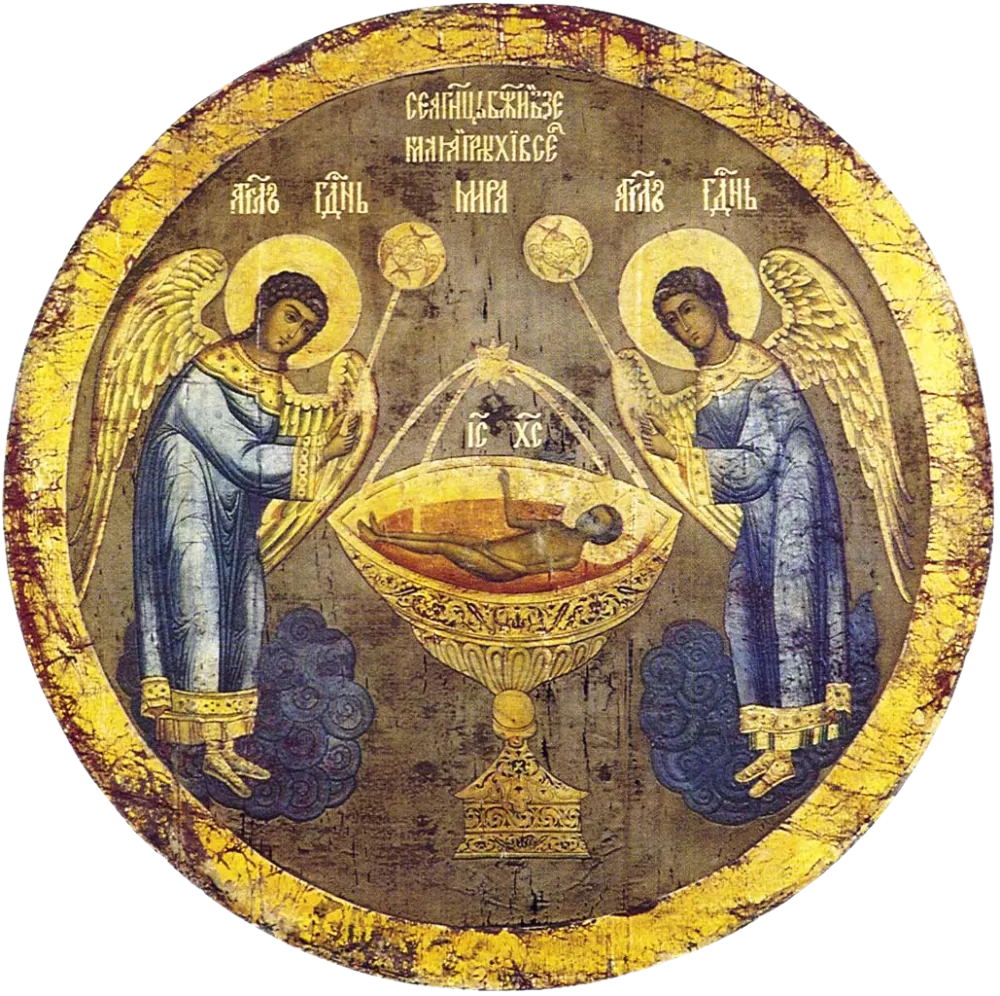
Follow the preparation of the bread and wine, the remembrance of the Church, and the Scripture heard in this rite.
Read the introduction, using “Terms used in this lesson” for unfamiliar words.
Read Isaiah, St. John’s Gospel, and the psalm in order, noticing their connection to the Lamb and the remembrance of the Theotokos.
Read the three Fathers’ comments on the particles, the prepared bread, and Christ’s offering.
Try an optional study question, then keep an observation or question for the next parish meeting in your notes.
Terms used in this lesson
Proskomide / prothesis
The preparation of the bread and wine for the Eucharist. Prothesis also names the table of oblation where the gifts are prepared. This preparation is distinct from the consecration in the Eucharistic prayer.
Prosphoron
A loaf of bread offered for the Divine Liturgy; the plural is prosphora. A portion is cut from it as the Lamb, and smaller particles are taken for commemorations.
The Lamb
The portion of bread prepared for the Eucharist and marked with the seal IC XC NIKA, “Jesus Christ conquers.” The name points to Christ, whom St. John the Baptist calls the Lamb of God.
Diskos, chalice, and asterisk
The diskos is the raised plate holding the Lamb and particles. The chalice is the cup prepared with wine and water. The asterisk is the star-shaped metal support that keeps the covering cloth above the bread.
Commemorative particles
Small portions of bread placed beside the Lamb in remembrance of the Theotokos, the saints, and the faithful living and departed. The prepared gifts express the Church’s prayer and remembrance.
Theotokos
The title “Birthgiver of God,” used for the Virgin Mary because the One born of her is truly God. She is commemorated beside Christ in the preparation of the gifts.
Preparing the Eucharistic gifts
Hands-on with prosphoron and demonstration of the rite. What is the origin of the gifts? Where do the bread and wine start? How do they arrive? What happens with and to them? How are the gifts treated and prepared, and why? The rite of Proskomide is a powerful example of how Scripture shapes worship, and how worship interprets and manifests the living Word, and how both orient and transform the lives of the faithful. Note about the relationship between Proskomide and the Great Entrance.
The Lamb of God and the royal bride
Read Isaiah’s prophecy of the suffering servant, then hear St. John the Baptist name Christ as the Lamb of God. The psalm’s royal bride accompanies the remembrance of the Theotokos.
Isaiah 53
SAAS (Orthodox Study Bible Old Testament)
Isaiah describes the Lord’s Servant, who suffers without opening His mouth, bears the sins of others, and is vindicated by God. The Church reads this prophecy in the light of Christ’s Passion.
O Lord, who has believed our report, and to whom was the arm of the Lord revealed? We proclaimed His presence as a Child, as a Root in a thirsty land. He had no form or glory, and we saw Him; and He had no form or beauty. But in comparison to all men, His form was lacking in honor. He was a man in suffering and knew how to bear sickness. His face was turned away, and He was dishonored and not esteemed. He bears our sins and suffers for us, yet we considered Him to be in pain, suffering, and ill-treatment. But He was wounded because of our lawlessness, and became sick because of our sins. The chastisement of our peace was upon Him, and by His bruise we are healed. All we like sheep have gone astray. Man has gone astray in his way, and the Lord delivered Him over for our sins. Although He was ill-treated, He opened not His mouth. He was led as a sheep to the slaughter, and as a lamb is silent before his shearers, so He opens not His mouth. In His humiliation His judgment was taken away, and who will declare His generation? For His life is taken from the earth, and because of the lawlessness of My people He was led to death. I will appoint evil men for His burial and rich men for His death, because He committed no lawlessness, nor was deceit found in His mouth. The Lord wishes to cleanse Him of His wound, and if You give an offering for sin, Your soul shall see a long-lived seed. The Lord wishes to take away the pain of His soul, to show Him light, to form Him with understanding, and to pronounce righteous the Righteous One who serves many well; and He shall bear their sins. Therefore He shall inherit many, and will divide the spoil with the strong, because His soul was delivered over to death. He was considered among the lawless, and He bore the sins of many, and was delivered over because of their sins.
As the priest cuts out the Lamb, words from this chapter accompany the action. Read the whole prophecy to understand the innocent suffering and saving self-offering recalled in the preparation.
St. John the Baptist identifies Jesus as the Lamb of God and explains his testimony by recalling the descent of the Holy Spirit.
The next day John saw Jesus coming toward him, and said, “Behold! The Lamb of God who takes away the sin of the world! This is He of whom I said, ‘After me comes a Man who is preferred before me, for He was before me.’ I did not know Him; but that He should be revealed to Israel, therefore I came baptizing with water.”
And John bore witness, saying, “I saw the Spirit descending from heaven like a dove, and He remained upon Him. I did not know Him, but He who sent me to baptize with water said to me, ‘Upon whom you see the Spirit descending, and remaining on Him, this is He who baptizes with the Holy Spirit.’ And I have seen and testified that this is the Son of God.”
The central portion cut from the prosphoron is called the Lamb. This name directs our attention to Jesus Christ, who takes away the sin of the world.
This royal wedding psalm describes the king and the queen standing at his right hand. In the rite of preparation, its words accompany the commemoration of the Mother of God.
There are daughters of kings in Your honor;
The queen stood at Your right hand in apparel interwoven with gold,
And adorned and embroidered with various colors.
The particle in honor of the Theotokos is placed at the right of the Lamb. The psalm helps us recognize the royal image expressed by this arrangement.
The people remembered. The gifts prepared. Christ’s saving offering.
Read these three commentaries alongside the preparation of the bread and wine. Notice how remembrance, the gifts, and Christ’s saving work belong together.
St. Symeon of Thessaloniki
The Liturgical Commentaries: Explanation of the Divine Temple · §107 · Selected excerpt · Course handbook, p. 5.
St. Symeon explains why particles are offered in honor of the saints and in prayer for the living and the departed. These particles represent the people being commemorated.
A discussion has come down to us from the fathers that the offered particles provide great advantage, for they are there in place of the persons for whom they are offered, and are a sacrifice offered on their behalf to God, just as the priest says in offering them “Receive, Lord, this sacrifice.” The particles offered for the saints, then, are for their glory and honor, and their ascent in worthiness and greater acceptance of divine illumination. Those for the faithful departed are for the remission of sins, and the union of divine grace, while those for the living—provided they lead lives of repentance—are for the deliverance from terrors, for the forgiveness of sins and for the hope of eternal life.
The preparation gathers concrete people into the Church’s prayer. The commemorations honor the saints and seek mercy, forgiveness, and eternal life for the faithful.
A Commentary on the Divine Liturgy, p. 34–35 · Chapter 6 · Selected excerpts · Course handbook, p. 5.
St. Nicholas Cabasilas explains the preparation at the prothesis, the table where the gifts are made ready. He distinguishes the bread dedicated to God here from its later consecration, and describes how the priest’s words and gestures recall Christ’s Passion.
As long as it remains in the prothesis, the bread thus separated from the rest is still only bread. But it has acquired a new characteristic: it is dedicated to God; it has become an offering, since it represents our Lord during the first phase of his life on earth, when he became an oblation... the priest expresses in words or represents by his gestures all that he knows of the solemn sacrifice, as far as he can with the means at his disposal. Thus he shows how the Lord began his Passion, how he died, how his side was pierced with a lance, and how, as the Gospel tells us, blood and water flowed from the wound.
The preparation teaches through action as well as words. The cutting, piercing, and mixing of the gifts call to mind Christ’s saving death; they do not mean that the bread has already become His Body at the preparation.
On the Divine Liturgy, p. 71 · §20 · Course handbook, p. 6.
St. Germanos interprets the bread offered for the Liturgy in light of the Incarnation and Christ’s voluntary self-offering. He joins Christ’s words about the bread from heaven to the prophetic image of the Cross.
The bread of offering, that is to say, which is purified, signifies the superabundant riches of the goodness of our God, because the Son of God became man and gave himself as an offering and oblation in ransom and atonement for the life and salvation of the world. He assumed the entirety of human nature, except for sin. He offered himself as first-fruits and chosen whole-burnt offering to the God and Father on behalf of the human race, as is written: “I am the bread which came down from heaven,” and “He who eats this bread will live for ever” (John 6:51). About this the Prophet Jeremiah says: “Come, let us place a stake in his bread” (11:19 LXX), pointing to the wood of the cross nailed to his body.
The gift is understood through Christ’s whole saving work: He truly became man and offered Himself for the life of the world.
Further studyAdditional Scripture and early Christian teaching
Explore these optional readings and commentary after the lesson.
Additional Scripture readings
John 19:31–37
NKJV (Orthodox Study Bible New Testament)
After the Crucifixion, soldiers come to the three crucified men to hasten their deaths before the Sabbath. They find Jesus already dead; St. John then records the piercing of His side and insists on the truth of the testimony.
Therefore, because it was the Preparation Day, that the bodies should not remain on the cross on the Sabbath (for that Sabbath was a high day), the Jews asked Pilate that their legs might be broken, and that they might be taken away. Then the soldiers came and broke the legs of the first and of the other who was crucified with Him. But when they came to Jesus and saw that He was already dead, they did not break His legs. But one of the soldiers pierced His side with a spear, and immediately blood and water came out. And he who has seen has testified, and his testimony is true; and he knows that he is telling the truth, so that you may believe. For these things were done that the Scripture should be fulfilled, “Not one of His bones shall be broken.” And again another Scripture says, “They shall look on Him whom they pierced.”
Wine and water are mixed in the chalice, and the lance recalls Christ’s pierced side. This passage gives the Gospel setting for the blood and water named by St. Nicholas Cabasilas.
St. Paul warns the Corinthians against sharing in idolatrous meals. He explains the real communion with Christ and with one another expressed in the Church’s cup and bread.
The cup of blessing which we bless, is it not the communion of the blood of Christ? The bread which we break, is it not the communion of the body of Christ? For we, though many, are one bread and one body; for we all partake of that one bread.
The many people commemorated around the Lamb belong to the Church whose unity is nourished by communion in Christ. St. Paul is speaking of Eucharistic communion, toward which the prepared gifts are directed.
The Liturgical Commentaries: On the Sacred Liturgy, p. 231 · §104
St. Symeon looks at the prepared diskos: the Lamb at the center, the particle of the Mother of God at its right, and the commemorative particles around it. When he speaks of people as deified, he means that they receive God’s grace, not that they become God by nature.
But let us see how both through this divine symbol and through the action of the sacred prothesis we behold Jesus Himself and His Church all as one. With Christ the true light at the center, the Church has obtained life eternal and is enlightened and sustained by Him. For He is in the center through the bread on the diskos, while his Mother is at his right hand through the particle, and the angels and saints are to the left; below is the whole pious gathering of those who believe in Him. And this is the great mystery: God among men and God in the midst of gods, deified by the one truly God by nature, who was incarnated for them. And this is the kingdom of the age to come and the reign of eternal life; God with us whom we both see and of whom we partake.
The arrangement helps us see the Church gathered around Christ. The particles call to mind real people and the life they receive from Him.
A Commentary on the Divine Liturgy, p. 39 · Chapter 10 · Selected excerpt
St. Nicholas Cabasilas is explaining the commemorations at the preparation: gifts offered in honor of the Mother of God and the saints, and for the remission of sins of the living and the departed. His two motives are gratitude for gifts already received and prayer for blessings still sought.
In our offering of these gifts to God, both motives are combined; we offer them both because of what we have received already and in order that we may receive yet more, in thanksgiving and in supplication; we thank him for the good things received and ask him for those blessings yet to come. So the same gifts are at once thank-offerings and supplicatory.
The preparation joins thanksgiving to intercession. We remember God’s gifts before bringing Him our needs and the names of those for whom we pray.
How do the words of Isaiah and St. John the Baptist change the way you see the preparation of the gifts?
What does it mean to bring bread, wine, and the names of the living and departed into the Church’s prayer?
St. Nicholas Cabasilas distinguishes preparation from consecration. How does that help you follow the movement toward the Great Entrance and the Eucharistic prayer?
Notes, observations & questions
Keep something you noticed, or a question for the next parish meeting.
Enable JavaScript to save notes in your browser.
Importing merges the backup with your notes. It keeps existing text. Notes do not sync automatically between devices.
Sources
The Bible editions are the Orthodox Study Bible: St. Athanasius Academy Septuagint (SAAS) for the Old Testament and NKJV for the New Testament. Source links open the selected text or source page in a new tab.
Scripture in Service: A Parish Study of the Divine Liturgy, Lesson 3, printed pp. 5–6