Begin with the purpose of worship, then follow Scripture and the Fathers into the Church’s common life in Christ.
Read the introduction, using “Terms used in this lesson” for unfamiliar words.
Read the three Scripture selections in order: the heavenly assembly, Melchizedek’s offering, and incense with the prayers of the saints.
Read the four Fathers’ comments on Sunday, sacred symbols, prayer toward the East, and the Church’s unity.
Try an optional study question, then keep an observation or question for the next parish meeting in your notes.
Terms used in this lesson
Divine Liturgy
The Church’s Eucharistic service, in which the faithful hear Scripture, offer prayer and thanksgiving, and receive Holy Communion.
Communion / Eucharist
Eucharist means thanksgiving. Here, Communion is our participation in the Body and Blood of Christ, by which we are united with Him and with one another.
Mystagogy
Guidance into the mysteries of the Church through reflection on the worship in which we participate. This course connects the actions of the Liturgy with Scripture and life in Christ.
Daily cycle
The pattern of services and prayer through the day and night, including Vespers in the evening and Orthros (Matins) in the morning. The Eucharistic Liturgy gathers up the Church’s worship in Communion with Christ.
Censer
The vessel in which incense is burned during worship. Revelation joins incense at the heavenly altar with the prayers of the saints.
Archetype
The original or pattern reflected by an image. St. Maximos uses this word as he describes the Church reflecting God’s work of gathering and uniting.
Overview of worship and the context of the Divine Liturgy
There is a pre-Christian origin and order to our services; their source is ultimately God. In the Church, worship finds its true purpose. The organism of the Church has a rhythm. Services are appointed around the clock, daily. The Divine Liturgy is not strictly subject to the clock with respect to this rhythm. All worship points us to Christ, to Communion.
The heavenly assembly, the offering, and prayer
These three readings introduce the worship we will explore throughout the course: drawing near to God, offering bread and wine, and praying with the whole Church. Read each passage with its connection to the Liturgy.
Hebrews 12:18, 22–24
NKJV (Orthodox Study Bible New Testament) · Verses 18–19 and 22–24; two excerpts
Hebrews contrasts the fearful encounter at Sinai with the heavenly assembly to which Christians draw near through Jesus. The first excerpt describes the mountain and the voice that the people feared; the second leads to Christ, the Mediator of the new covenant.
For you have not come to the mountain that may be touched and that burned with fire, and to blackness and darkness and tempest, and the sound of a trumpet and the voice of words, so that those who heard it begged that the word should not be spoken to them anymore.
But you have come to Mount Zion and to the city of the living God, the heavenly Jerusalem, to an innumerable company of angels, to the general assembly and church of the firstborn who are registered in heaven, to God the Judge of all, to the spirits of just men made perfect, to Jesus the Mediator of the new covenant, and to the blood of sprinkling that speaks better things than that of Abel.
The Liturgy gathers us before God with the angels and the whole Church. Listen for this heavenly company in the Church’s hymns, and for the new covenant as the Eucharistic prayer recalls Christ’s saving work.
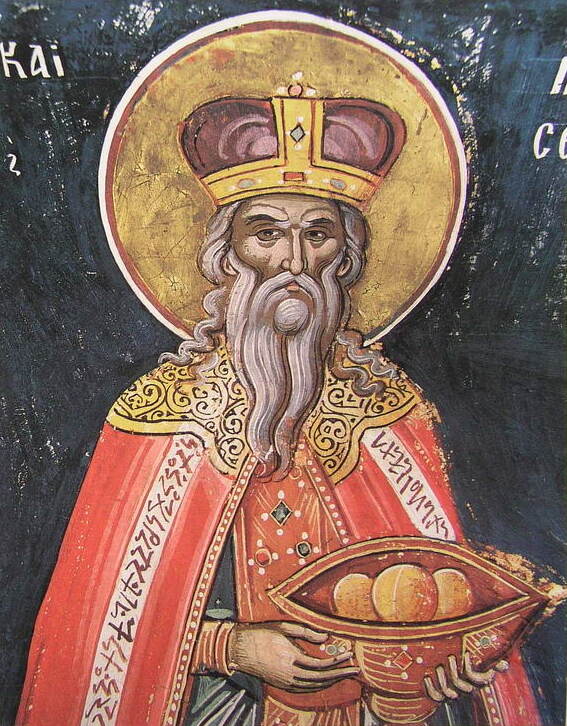
After Abram rescues Lot, Melchizedek, king of Salem and priest of God Most High, meets him with bread and wine and blesses him. Abram responds by giving a tenth of what he has brought back.
Now Melchizedek the king of Salem brought out bread and wine; he was the priest of God Most High. He blessed Abram and said, “Blessed be Abram of God Most High, Creator of heaven and earth; and blessed be God Most High, who delivered your enemies into your hands.” Then Abram gave him a tithe of all.
This meeting brings bread and wine, priesthood, blessing, and thanksgiving together before the time of Christ. Keep those elements in mind as the course turns to the preparation and offering of the Eucharistic gifts.
NKJV (Orthodox Study Bible New Testament) · Verses 3–4
St. John sees an angel at the heavenly altar. The incense is offered with the prayers of the saints, and the next verse describes their ascent before God.
Then another angel, having a golden censer, came and stood at the altar. He was given much incense, that he should offer it with the prayers of all the saints upon the golden altar which was before the throne. And the smoke of the incense, with the prayers of the saints, ascended before God from the angel’s hand.
When you see and smell incense in church, remember that worship includes the prayers of God’s people. This vision helps us recognize the connection between the visible actions of the service and prayer before the heavenly throne.
The Sunday assembly. The sacred symbols. The hope of Christ. The unity of the Church.
Read these four commentaries slowly. Each helps us understand the setting and purpose of the worship we share.
St. Justin the Philosopher and Martyr
First Apology · Chapter 67 · Course handbook, p. 1.
Explaining Christian worship to Roman rulers in the second century, St. Justin describes the Sunday assembly: Scripture readings, instruction, common prayer, the Eucharist, and care for people in need. He closes that account by explaining why Christians gather on Sunday.
Sunday is the day on which we all hold our common assembly, because it is the first day on which God, having wrought a change in the darkness and matter, made the world; and Jesus Christ our Savior on the same day rose from the dead. For He was crucified on the day before that of Saturn (Saturday); and on the day after that of Saturn, which is the day of the Sun, having appeared to his apostles and disciples, he taught them these things, which we have submitted to you also for your consideration.
The weekly gathering is rooted in creation and Christ’s Resurrection. Bring that meaning to the Sunday Liturgy: the assembly’s day already proclaims the life God gives.
How does remembering Christ’s Resurrection change the way you approach the Sunday assembly?
St. Symeon of Thessaloniki
The Liturgical Commentaries: Explanation of the Divine Temple, p. 85 · §9 · Course handbook, p. 1.
St. Symeon has been describing baptism, chrismation, and Communion as gifts of Christ. He then turns to the Church’s inherited rites and the divine mystery they communicate.
Therefore the Church constantly enacts what it has received from the beginning and through sacred symbols teaches what is beyond understanding and even things that are enacted visibly have participated in such great glory that they are marvelous to all. But the mind of all persons does not attain an understanding of the rites; therefore many are at a loss and seek reasons for them. In fact the rites are beyond all understanding, and no intelligence—either human or angelic—could explain God’s incarnation, or the manner of communion with God, or all that the Church proclaims and enacts.
The gestures and objects of worship invite attentive participation in what Christ gives. Studying them can deepen our attention, while Communion with God remains greater than our explanations.
Which action in the Liturgy would you like to attend to more carefully, even before you fully understand it?
St. Germanos of Constantinople
On the Divine Liturgy, p. 63 · §11 · Course handbook, p. 2.
St. Germanos explains the Church’s prayer toward the East through Christ’s appearing, the hope of Paradise, and His coming again. “Orient” means the rising or the East; the image of sunrise directs our hope toward Christ.
Praying toward the East is handed down by the holy apostles, as is everything else. This is because the comprehensible sun of righteousness, Christ our God, appeared on earth in those regions of the East where the perceptible sun rises, as the prophet says: “Orient is his name” (Zech 6:12); and “Bow before the Lord, all the earth, who ascended to the heaven of heavens in the East” (cf Ps 67:34); and “Let us prostrate ourselves in the place where His feet stood” (cf Ps 67:34); and again, “The feet of the Lord shall stand upon the Mount of Olives in the East” (Zech 14:4). The prophets also speak thus because of our fervent hope of receiving again the paradise in Eden, as well as the dawn of the brightness of the second coming of Christ Our God, from the East.
The direction of prayer expresses the Church’s shared expectation of Christ. As you stand with the congregation, consider how bodily posture and orientation can turn the heart toward that hope.
How might the Church’s common direction of prayer help you remember the hope of Christ’s return?
St. Maximos the Confessor
The Church’s Mystagogy, p. 186–187 · Chapter 1 · Selected excerpts · Course handbook, p. 2.
St. Maximos begins his contemplation of the Church by considering how she reflects God’s work of gathering and uniting. Here he speaks of people with very different lives receiving one identity in Christ.
At the first level of contemplation the holy Church bears the imprint and image of God, since it has the same activity as he does by imitation and in figure. For God who made and brought into existence all things by his infinite power contains, gathers, and limits them and in his Providence binds both intelligible and sensible beings to himself and to one another… It is in this way that the holy Church of God will be shown to be working for us the same effects as God, in the same way as the image reflects its archetype. For numerous and of almost infinite number are the men, women, and children who are distinct from one another and vastly different by birth and appearance, by nationality and language, by customs and age, by opinions and skills, by manners and habits, by pursuits and studies, and still again by reputation, fortune, characteristics, and connections: All are born into the Church and through it are reborn and recreated in the Spirit. To all in equal measure it gives and bestows one divine form and designation, to be Christ’s and to carry his name. In accordance with faith it gives to all a single, simple, whole, and indivisible condition… Thus to be and to appear as one body formed of different members is really worthy of Christ himself, our true head.
The people assembled for worship bring many differences with them. Their unity comes from belonging to Christ. Consider the common prayers and Communion in the light of that shared life.
Whose presence in the parish helps you see the breadth of the one body St. Maximos describes?
Further studyAdditional Scripture and early Christian teaching
Explore these optional readings and commentaries alongside the lesson.
Additional Scripture readings
Acts 2:42–47
NKJV (Orthodox Study Bible New Testament) · Verse 42
After the preaching of St. Peter at Pentecost and the baptism of those who received his word, Acts describes the common life of the believers in Jerusalem.
And they continued steadfastly in the apostles’ doctrine and fellowship, in the breaking of bread, and in prayers.
Teaching, fellowship, the breaking of bread, and prayer belong together. Read the rest of the passage to see how worship is joined to generosity and daily life, then consider those connections in your parish.
NKJV (Orthodox Study Bible New Testament) · Verse 17
St. Paul has just spoken of the cup as communion in Christ’s blood and the bread as communion in His body. He then draws out what this means for the many who share the bread.
For we, though many, are one bread and one body; for we all partake of that one bread.
Read this beside St. Maximos on one body formed of different members. Communion in Christ gives the assembly’s unity its center and calls us to care for one another.
St. Ignatius urges the Christians in Philadelphia to remain united with their bishop, presbyters, and deacons. His appeal concerns the common Eucharistic life of the Church.
Take heed, then, to have but one Eucharist.
He goes on to speak of one flesh of Christ, one cup, and one altar. His call to unity complements the lesson’s focus on the Church gathered in Christ and the one body described by St. Maximos.
The introduction says that all worship points us to Christ, to Communion. Where do you begin to see that movement in a service you know?
St. Justin connects Sunday with creation and the Resurrection. How could that shape your preparation for the next Sunday Liturgy?
Which gesture, object, or direction of prayer would you like to ask about at the next parish meeting?
St. Maximos describes very different people becoming one body in Christ. How might you express that unity toward someone in your parish this week?
Notes, observations & questions
Keep something you noticed, or a question for the next parish meeting.
Enable JavaScript to save notes in your browser.
Importing merges the backup with your notes. It keeps existing text. Notes do not sync automatically between devices.
Sources
The Bible editions are the Orthodox Study Bible: St. Athanasius Academy Septuagint (SAAS) for the Old Testament and NKJV for the New Testament. Scripture excerpts are labelled; source links open the complete selected passage in a new tab.
Scripture in Service: A Parish Study of the Divine Liturgy, Lesson 1, printed pp. 1–2